
A modern cruise ship can carry thousands of passengers, stand taller than many buildings and cost well over $1 billion. So you might expect building one to take forever.
Surprisingly, the actual construction can happen much faster than you might think.

But there’s a big difference between the day a new ship is announced and the day its first paying passengers step onboard. And the journey between the two involves some fascinating stages most cruisers never get to see.
How Long It Really Takes
A modern cruise ship typically takes around two years to build, although the entire process from ordering the ship to welcoming the first passengers can stretch over several years.
Exactly when you start counting makes a difference. Steel cutting marks the start of production, while the keel-laying comes later, when the first major sections of the ship begin to come together.
Royal Caribbean’s newest ship, Legend of the Seas, is a great example. As the biggest cruise ship in the world, the scale of the ship is incredible, yet she took just over two years to go from keel-laying to completion.
Legend of the Seas had her keel laid in May 2024 and was officially delivered to Royal Caribbean in June 2026, before welcoming her first passengers the following month.
So while the complete process of designing and planning a new cruise ship takes years, the actual construction happens surprisingly quickly. And when you see everything that has to happen during that time, two years doesn’t seem very long at all.
The Stages Of Building A Cruise Ship
It’s generally accepted that there are ten main stages in building a cruise ship. Here’s a look at each one in detail…
1. Order Placed
The very first step in a ship being built is the order being placed, which stands to reason. Cruise lines will normally make an announcement to the media about their new ship order, but there’ll be very few details revealed at this stage.
We’ll typically find out the class of the ship and the planned date of her launch, often three to six years away from the first announcement.
If the class is announced and it’s an existing class, we have some understanding of the size of the ship, but they are rarely identical twins, so it doesn’t guarantee anything.
Sometimes, cruise lines will announce the intended passenger capacity at this stage, too, but often, we don’t know much at all. Icon of the Seas was announced in 2016, but it was only in 2022 that we found out that the Icon Class would be larger than the Oasis Class, for example.
2. Steel-Cutting Ceremony
The second step in the process is the steel-cutting ceremony, and this is where the actual build technically starts. It’s when the first pieces of steel are cut for the ship, normally in a ceremony held with representatives of the cruise line at the senior management level.

By this point, we’ll normally have the announcement of the name of the ship, but not always. And the first bits of steel being cut don’t look like much at all – it’s very much a ceremony for show, to help build up the awareness of the impending ship launch.
The steel that’s cut will eventually be used in the ship, but only once the manufacturing process really gets underway.
3. Keel-Laying Ceremony
By the time we get to the keel-laying ceremony, we can say that the actual manufacturing process of the ship has truly begun.
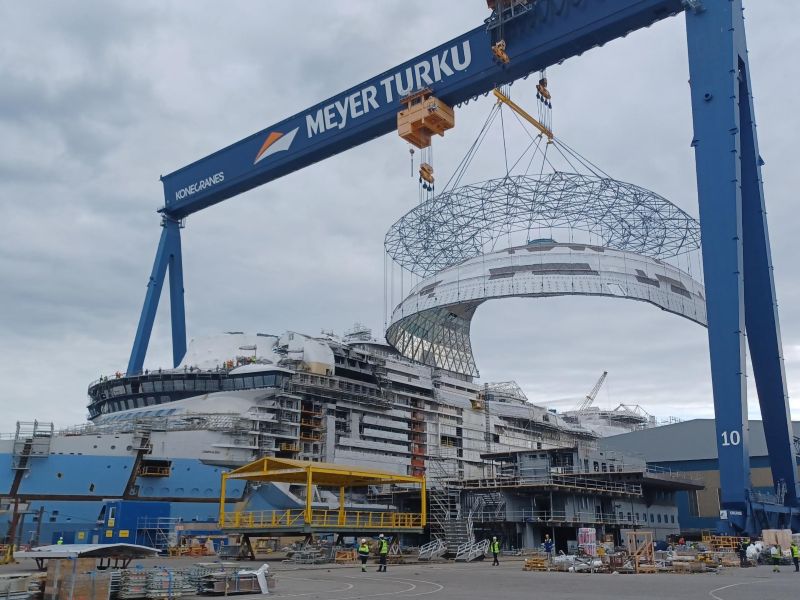
The keel is the lowest part of the ship, and during this ceremony, it is laid into place in the dry dock where the ship is going to be put together using massive cranes.

Essentially, it’s putting the base layer down for the ship so that the rest of the ship can be built on top of it. There’s a lot of ceremony involved here, including the coin laying ceremony, where gold coins are either laid into the keel block to be collected later for welding somewhere around the ship, or they are welded in place now to the keel.

This ceremony will be carried out by the first Godmother of the ship, but they likely won’t be the same Godmother who christens the ship later. Often it’s someone from the shipyard, or from the cruise line, or one person from each.
With the keel laid, the ship will now be assembled in large blocks. All of the extra bits, like propellers and even the waterslides, will be added.

4. Float Out
By the time we get to the float out, the ship has literally started to take shape – it resembles a cruise ship from the outside, and many of the internal structures have been added, including the cabins, which are built elsewhere.
The float out is the point where the ship enters the water. The Godmother (likely the same one from the coin-laying ceremony) will smash a bottle of Champagne against the bow, and the dry dock will be flooded.

The ship will then be floated out of the yard to a new location where building work continues, freeing up the dry dock for the next ship. It’s at this stage that the rest of the ship is fitted out with the various furnishings and features.

5. Sea Trials
Once the framework of the ship is in place and it is ready, it will undergo sea trials. Various crew will join shipyard officials, insurance company reps and other safety inspectors while the ship makes its first trips out onto the ocean.

The ship won’t be finished yet – there’s still a fair amount of work to be done – but this is the chance for the safety of the ship to be checked, and for the crew to get used to how this brand new ship handles.

No two ships are the same, so this is important – and various manoeuvres will be carried out so that the crew understands how quick she is and how easy she is to turn.
With the sea trials complete, the ship returns to the shipyard for the last parts of the build and furnishing.

6. Handover Ceremony
The handover ceremony is where the ship is presented to the cruise line and signed over from the shipyard. Again, there’ll normally be a fair amount of pomp around this, but the ship is still far from finished, despite how she may look.
From the outside, she will look complete, but things like soft furnishings and, more importantly, supplies won’t be on board. So at this stage, the crew will likely join the ship for the first time, and the ship will brace itself for its first actual sailing.

7. Shakedown Voyage
The very first sailing of a ship is the shakedown voyage. This is basically taking the ship for a run-out to see how she works and to get the crew acclimated to her. A lot of the training will take place on this sailing.
The cruise line might use this as the first opportunity to get travel agents and members of the media on board to promote the ship, as well as offer places to key people who were involved in the build, such as architects, engineers, and interior designers.
8. Inaugural Voyage
The inaugural voyage is not an ever-present step, and it’s sometimes combined with the shakedown voyage. This is considered to be the first sailing with passengers, but not paying guests. This will be the main one to host travel agents, media and sometimes even celebrity guests too. I was lucky enough to be invited to the Inaugural sailing of Disney Wish.

The point of this sailing is to generate a bit of publicity and to help sell the ship. Travel agents often get invited so that they can do a better job of talking about the ship to potential passengers in future.
Between the shakedown voyage and the inaugural voyage, the ship will be sailed to the port where her christening ceremony will take place.
9. Christening Ceremony
This is probably the most famous of the various ceremonies involved in the building of a ship. The christening ceremony will take place either at the home port of the ship, or at a convenient port elsewhere – it’s not uncommon for the christening of US-based ships to happen in Southampton.
Here, the Godmother (this time the ‘well-known’ one) will formally christen the ship by smashing a bottle of Champagne against the bow – though it’s all done using wires and buttons these days. You want to make sure the bottle breaks; otherwise, it’s bad luck!

There may be other special guests too, and the whole ceremony will be one big welcoming party for the ship. There’ll be a lot of media present, especially for bigger ships.
10. Maiden Voyage
The last stage is the maiden voyage – either the first sailing of a regular itinerary or often a transatlantic cruise where the ship will travel from Southampton or another European port to its home base in the US.
The key difference with this sailing is that it will be the first to accept paying customers, so everything has to be perfect in theory, although there will no doubt be a couple of minor teething problems, which hopefully won’t even be noticed by guests.
How Many Man-Hours It Takes To Build A Cruise Ship
Building a modern cruise ship can take millions of working hours, with thousands of people involved in everything from designing the ship to constructing the hull and fitting out the cabins.
For example, Fincantieri says that building each Explora Journeys ship requires more than 7 million working hours, with an average of 2,500 people employed over two to three years.
For the much larger MSC World Europa, the figures are even more impressive. Around 9.9 million working hours went into designing and building the ship, including 2 million hours on the steel structure and 6 million on outfitting and coordination.

So while a cruise ship might take around two years to physically build, the sheer number of people working on it means the total amount of labour involved is enormous.
Where Cruise Ships Are Built
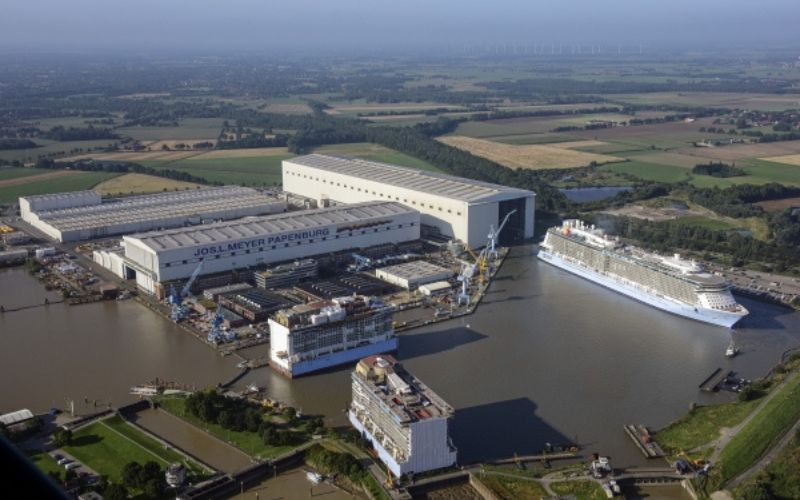
Cruise ships are built at dedicated shipyards – massive factories equipped with all the necessary tools and space for a ship to be built, including dry docks, cranes for lifting sections of the ships into place, and welding equipment. There are four main cruise shipyards in the world.
Not all parts of a cruise ship are built at a shipyard, though. Some elements, such as the cabins, may be built on a production line elsewhere and transported to the shipyard to be put into place. The shipyard is where the main sections of the ship are put together, rather than where each individual element is manufactured.
The four shipyards in the world capable of building cruise ships are:
- Meyer Werft – based in Germany and builders of ships such as P&O Cruises’ Iona, Disney Wish, and Odyssey of the Seas
- Meyer Turku – owned by Meyer Werft and based in Finland, builders of the Icon Class ships
- Chantiers de l’Atlantique – a French shipyard and builders of Wonder of the Seas, Celebrity Beyond and MSC Virtuosa
- Fincantieri – based in Italy and the builders of MSC Seaview, Carnival Horizon and Seven Seas Explorer among others
The Cost Of Building A Cruise Ship
Building a modern cruise ship can easily cost $1 billion or more, with the biggest and most advanced ships now approaching $2 billion.
Royal Caribbean’s Icon of the Seas and Star of the Seas, for example, each cost around $2 billion to build. That’s a huge increase from older ships, which could be built for a few hundred million dollars.
The final price depends on much more than the size of the ship. New technology, engines, entertainment venues, restaurants and increasingly elaborate attractions can all push construction costs higher.
And with cruise lines continuing to order increasingly ambitious new ships, billions more will be spent building the next generation.
Read more: How much does a cruise ship cost?
The Bottom Line
Building a cruise ship is an enormous undertaking. Years of planning happen before construction begins, followed by millions of working hours to turn huge sections of steel into a finished ship.
Yet considering the size and complexity of today’s biggest cruise ships, the fact that the physical construction can be completed in around two years is pretty incredible.
As passengers, we only ever see the finished result. But the next time you step aboard a brand-new cruise ship, it’s worth remembering just how much work went into getting her there.
TODAY’S BEST CRUISE DEALS!
Don’t miss these offers…

It’s actually “Chantiers de l’Atlantique”, not “Antique”. One of the most famous ships built there was the ocean liner Queen Mary 2, completed in 2004; previous ships included the French Line (Compagnie Generale Transatlantique) France (1962) and Normandie (1935).
Jenni.
Meyer Turku is in Finland not Turkey, and a lot of the early Cruise ships were built there!!
Neil