
A cruise ship anchor can weigh several tonnes, but the anchor itself isn’t actually what keeps the ship in place.
There’s much more going on beneath the surface, from hundreds of metres of heavy chain to the way the ship moves around its anchor point.
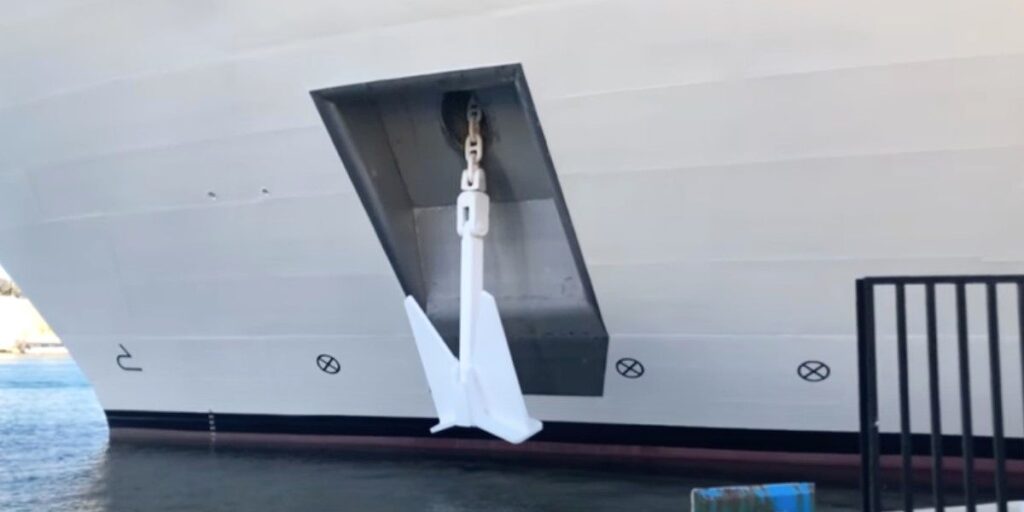
With help from my cruise ship pilot friend John, here’s how cruise ship anchors really work, including how they’re dropped, how they hold a huge ship in position and what happens when an anchor starts to drag.
Most Ships Have Multiple Anchors
Typically, a cruise ship will have two anchors, one on each side of the ship.
There’s an old saying that the starboard anchor is used in the southern hemisphere and the port anchor in the northern hemisphere. This is due to the Coriolis force, which causes storm systems to rotate clockwise in the north and anticlockwise in the south. Using the appropriate anchor can prevent cables from getting tangled when a second anchor is dropped.
But in reality, the anchors are alternated so that they wear equally.
Sometimes, if you’re cruising into a place and you’re going to be turning into a current slightly, it’s more prudent to put down the anchor, which is on the current side of the vessel.
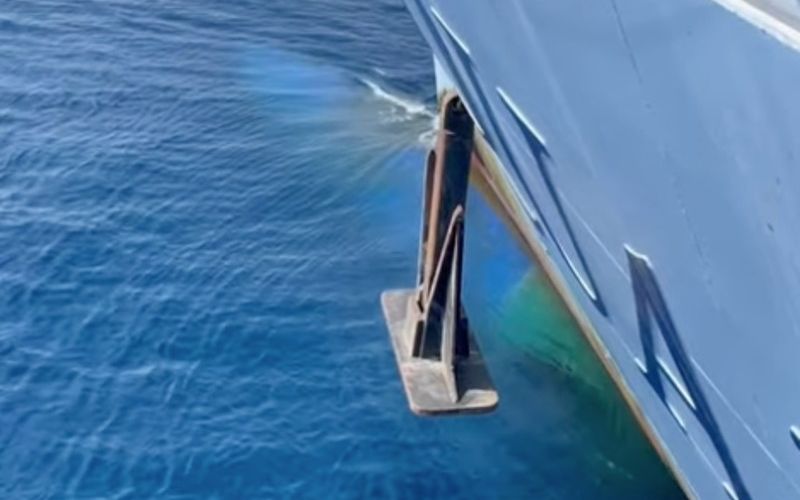
Anchor Weight Varies – Some Are Really Huge!
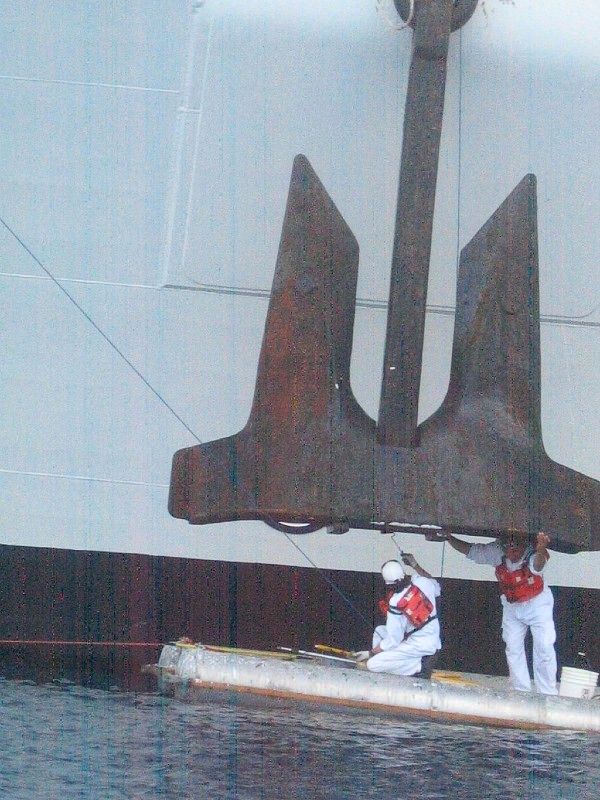
The weight of the anchor is determined by the size of the ship. On a large cruise ship, the anchor may weigh in the region of 8 tons. That’s about the same weight as an African elephant or a standard school bus.
Here’s a photo of the anchor of an average-sized cruise ship, the Norwegian Jewel, next to a person…
And below, you can see me with the anchor of the S.S. Great Britain – the world’s first ocean liner, which sailed from 1845 until 1886.
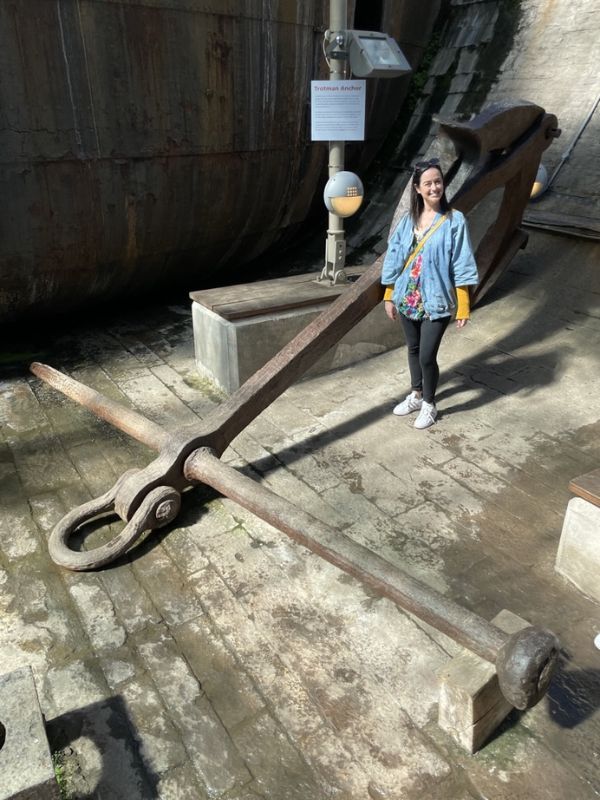
As you can see, the size is similar, although the shape of cruise ship anchors has changed quite a lot over the past 170 years.
Anchor Chain Length
Anchor chains are measured in lengths called shackles. One shackle of the chain is 15 fathoms long, which equates to 90 feet or approximately 27 metres.
Most cruise ships have chains that are either ten or eleven shackles long, but they could be up to 13 shackles long. So the anchor chains are around 900-990 feet or 270-297 metres long.
For comparison, Wonder of the Seas is 1,188 feet or 362 metres long. So the anchor chain is roughly as long as the ship, but it may be a bit longer or a bit shorter.
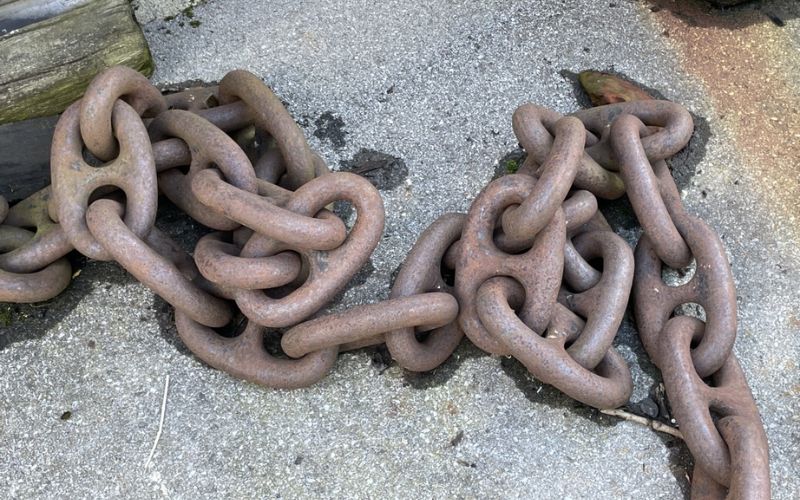
The Chain’s Pretty Heavy Too
For a large cruise ship, each link in an anchor chain weighs around 50 kg – that’s roughly the same weight as a 12-year-old child.
There are around 1,000 links in the chain, so the whole anchor chain will weigh around 50 tons. Of course, with smaller ships, the anchor and the chain will weigh less than this.
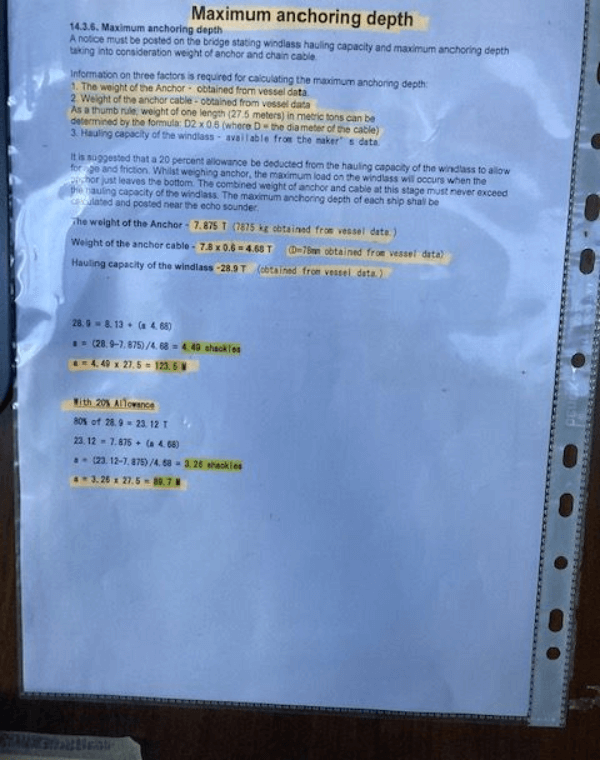
Not all of the chain is let out. When it comes to dropping the anchor, the general rule of thumb is to lay out four to five times the length of the water’s depth in chain.
So, if the water is 25 meters deep, you’ll need approximately 100 to 125 meters of chain. The length of the chain can vary due to wind and currents, and sometimes it’s necessary to let out more of the chain or shorten it.
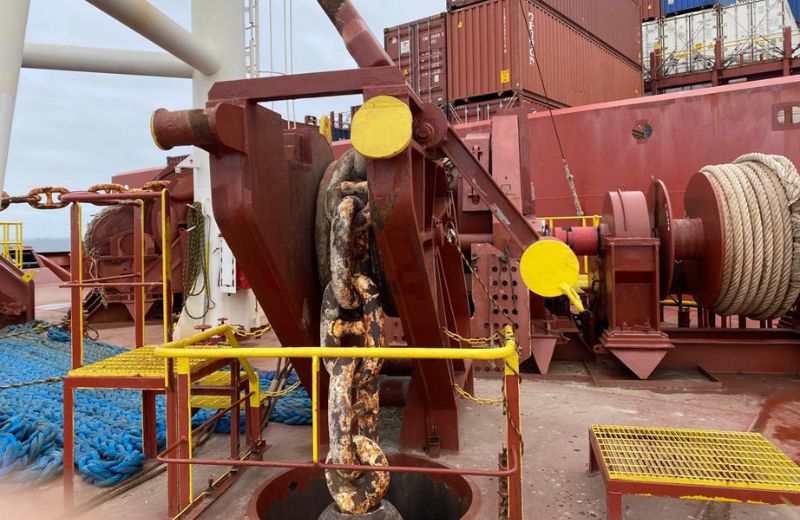
Anchor Chain Storage Explained
Anchor chains are contained in a chain locker on both the port and starboard sides. This is located underneath the windlass (the winch that recovers the anchor from the ocean floor), towards the front of the ship.
The end of the chain is secured to the ship, which is called the bitter end. In emergencies, the chain can be released by knocking out a pin in the bitter end. In dry docks, the entire chain can be removed and then reversed and put back in. This equalises the wear on it.
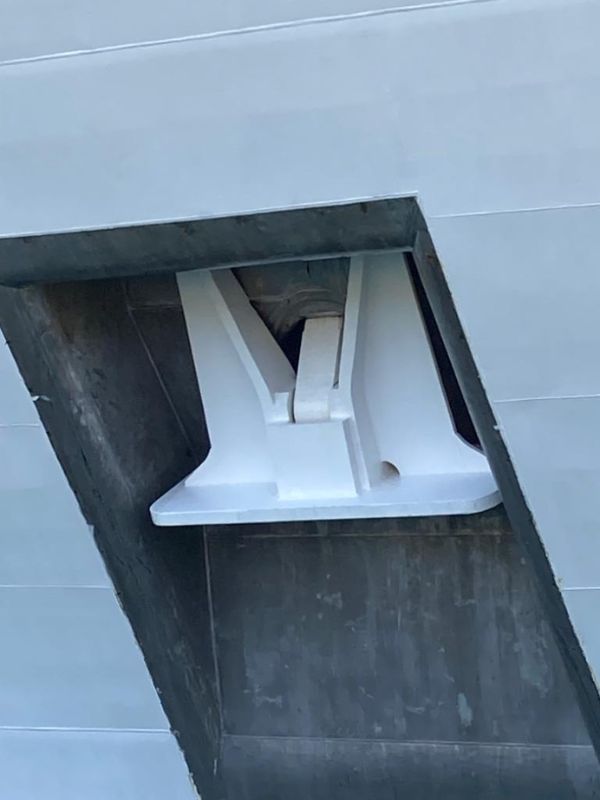
The pipe that the anchor cable chain goes down from the windlass to the outside of the ship is called the hawsepipe. The anchors are hauled up into this hawsepipe and secured in place. When a ship anchors, it does so at zero speed over the ground or with a very small amount of sternway.
When the Anchor Drops…
When a ship is brought to anchor, the speed is reduced to the minimum necessary for steering. The engines are then put into reverse to generate sternway, and the anchor is dropped onto the bottom.
The machine that’s used to drop and recover the anchor is called a windlass. This handy contraption is usually electrically powered on cruise ships, but usually hydraulically powered on tankers and cargo ships.
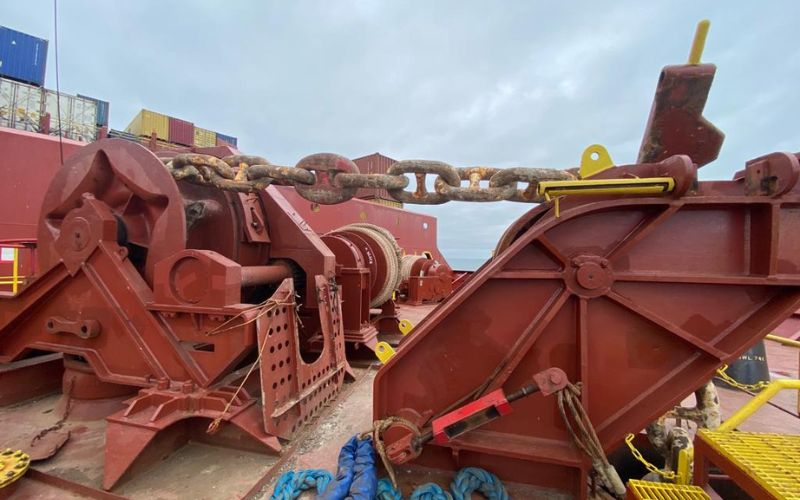
Letting go of the anchor is known as ‘walking the anchor out’. The anchor will be brought to just above the water, where it hangs free. The nautical term for this is a ‘cockbill and anchor’.
When it’s time to drop the anchor, an officer on the bridge will give the command to release it, and the brake on the windlass is released.
The anchor cannot be dropped all at once, or it will pile up. The speed at which the anchor drops is controlled by a brake.
This can be a pretty noisy and messy process, with dust and rust flying around. The anchor will hit the bottom of the ocean, and then the ship will start to lay it out.
Watching a ship come to anchor early in the morning can be quite the spectacle. If you’re lucky enough to see it, you may notice the wash from the propellers come alongside the vessel as it comes astern. Once the wash reaches the middle of the ship, it’s a sign that the ship has stopped moving through the water.
This interesting video shows how an anchor is dropped on Island Princess…
Then It Gets to Work…
The anchor isn’t working alone to hold the ship in place. When it reaches the seabed, the flukes will usually dig into the bottom while the heavy chain is laid out across the seabed.
The weight and curve of the chain, known as the catenary, help keep the pull on the anchor more horizontal. Together, the anchor, chain and seabed provide the holding power that keeps the ship in position.
Anchors Don’t Always Work
Some places are better for anchoring than others. On a chart on a ship, it indicates the nature of the bottom – whether it’s what’s known as ‘good holding ground’ or ‘poor holding ground’.
Good holding ground would suggest that the anchor will sit on the bottom there and will hold successfully. On poor holding ground, the anchor would not sit successfully on the seabed and would drag.
Mud or softer ground is very good holding ground, but harder ground generally isn’t. If an anchor drags, in other words, the ship is moving away from the anchor, and the cables come tight, the anchor breaks away from the bottom. Dragging can be caused by a number of things, like wind or current.
There are a number of remedies for this. The first method would be to lengthen the cable so you have a longer catenary. If this is unsuccessful, then the crew may have to pick the anchor up again and re-anchor in a different position.
If this is unsuccessful again, the vessel keeps tracking anchor, the only remedy is to pick up the anchor and go and steam off somewhere safe and just drift.
Anchors Can Be Used for Manoeuvring
Anchors can be used as a manoeuvring aid. While cruise ships typically have various tools such as bow thrusters, propellers and Azipods or rudders, there are occasions where an anchor can be useful.
The process involves lowering the anchor until it just touches the bottom, causing the ship to turn on that position. This transfers the steering point of the vessel to where the anchor comes out of the ship, and the ship will turn on that position.
Raising the Anchor
To recover the anchor, the process of dropping it is reversed. The officer on the bridge lets the captain know which way the cable is lying and how much weight is in it. Then, the ship will turn towards the cable to take the weight off it, and the anchor will be heaved back up onto the ship.
You can tell when the anchor comes off the bottom because it starts to sway very gently. This will be relayed to the bridge as ‘anchor away’.
The anchor is hauled up, and when it breaks the water, the term ‘anchor sighted’ will be relayed to the bridge. Then, it’s hauled all the way back up into the hawsepipe, and the message is ‘anchor home’.
When the anchor is sighted, the ship can commence moving safely forward.
The Bottom Line
Cruise ship anchors are much more complicated than simply dropping a huge piece of metal onto the seabed. The anchor, chain, seabed and movement of the ship all work together to keep a vessel safely in position.
Thanks to my cruise ship pilot friend John for helping me understand exactly what happens when a cruise ship drops and raises its anchor. Next time you’re anchored off a port, you’ll know just how much is going on beneath the surface.
TODAY’S BEST CRUISE DEALS!
Don’t miss these offers…

Very informative. I always thought the term ‘anchor away’ meant that it was being dropped. I didn’t realise that it meant it was away from the seabed.
Congratulations Jenni you deserve it.
Thank you!