
You might assume that every cruise ship has a huge rudder underneath to steer it through the water. But that’s not actually the case.
Some cruise ships do have rudders, while many modern ships use a completely different system that can turn a full 360 degrees.
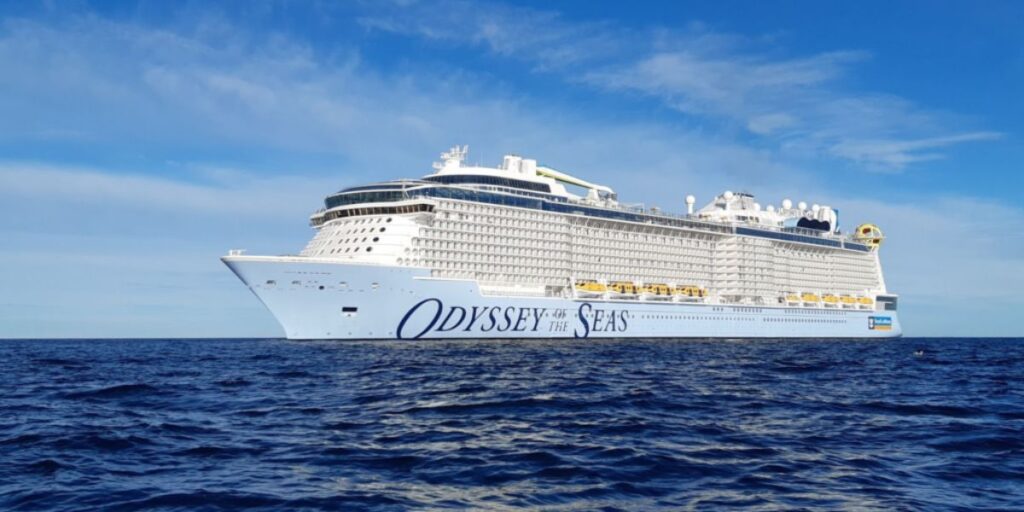
It all gets a little technical though, so I asked my friend John, who is a ship pilot, to help me understand exactly how cruise ships steer.
And once you see what’s going on underneath the ship, it all starts to make a lot more sense…
Rudders or Azipods: Knowing the Difference
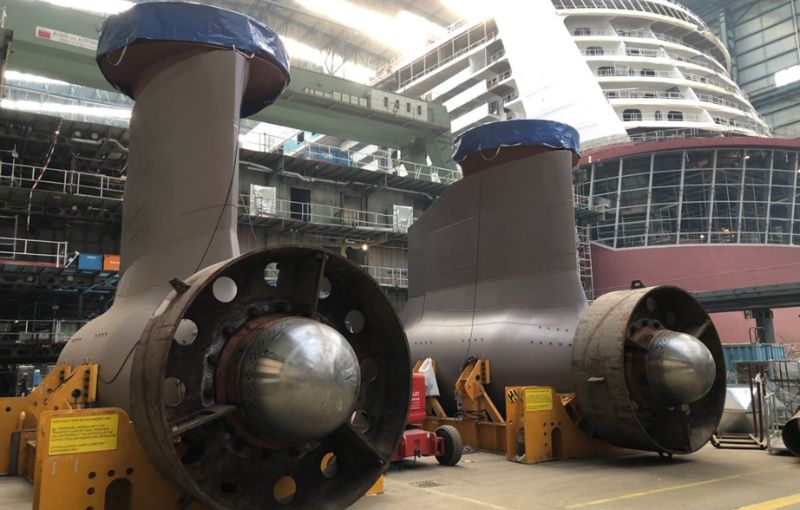
Some cruise ships have rudders, but others instead have podded propulsion known as Azipods.
Traditionally, cruise ships relied on rudders and varying propeller speeds for turning. However, many modern cruise ships now have podded propulsion, which combines the propeller and steering into a single unit. One of the best-known systems is ABB’s Azipod.
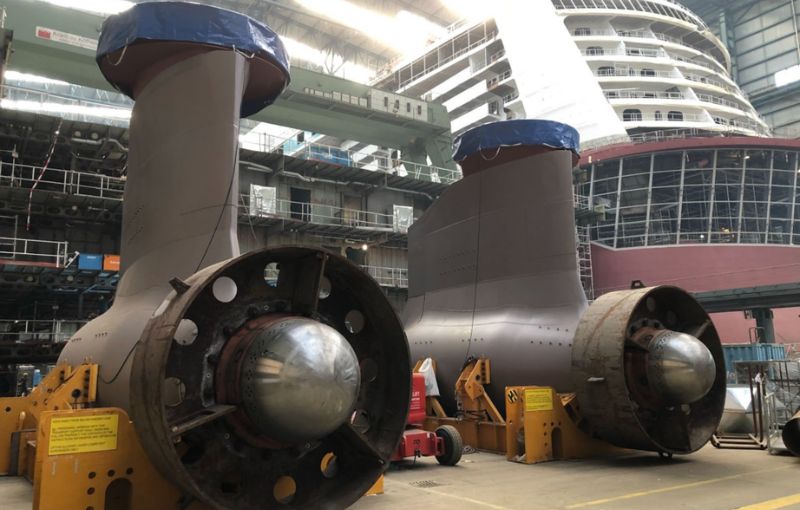
Rudders are still essential components of many modern vessels, including some cruise ships. They provide directional control and enable the ships to steer and navigate through water. Located at the stern of the ship, the rudder is used to turn the vessel or to maintain a course (by continual small adjustments)
Types of Rudders on Cruise Ships
There are several types of rudders in use today, each designed to cater to specific ship sizes and navigational needs. Some common types of rudders include:
- Semi-balanced rudder: A compromise between the spade and full-balanced varieties with some portion of the rudder surface forward of the axle. These normally have 35 degrees of movement each side of mid ship.
- High lift rudders: There are numerous designs, eg Becker, fishtail, and shilling to name a few. The advantage of fitting these is the increase in port slow-speed manoeuvrability. They can have 60 degrees of movement. The Becker-type rudders have a flap on the end which effectively gives 90 degrees
Different types of rudders are chosen based on factors such as ship size, manoeuvrability requirements, fuel economy and the speed at which the vessel is designed to operate
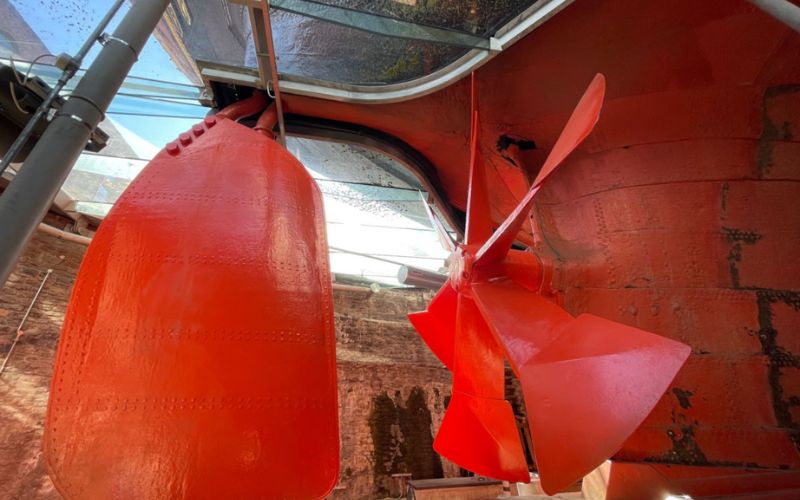
Cruise ships that don’t use pod propulsion generally have a twin-screw propeller design with a rudder mounted immediately behind the propeller (it can be slightly offset depending on propeller characteristics).
With two propellers and rudders, the result is an increase in port manoeuvrability. This is even better when coupled with bow thrusters. Sometimes, rudders can be operated independently at a slow speed to enhance manoeuvrability.
The Importance of Rudders on Cruise Ships
When it comes to cruise ships, adequate steering and directional control are crucial for providing a smooth, comfortable experience for passengers.
Rudders, or their modern alternatives (Azipods), enable cruise ships to make planned course changes, navigate tricky waterways, and avoid obstacles. The ability to execute fine control manoeuvres enhances safety and reduces the risk of collisions and other accidents.
Rudders or equivalent steering technologies are absolutely vital to ensure the smooth operation and safety of cruise ships.
Other Navigation Systems on Cruise Ships
As well as rudders, modern cruise ships employ advanced navigation systems to ensure the safety and efficiency of the vessels.
Azipod Propulsion
A significant advancement in ship navigation is the introduction of Azipod pod-type propulsion systems. Cruise ships that utilise Azipod propellers do not have conventional rudders.
Azipods are pod-like structures with electric motors, mounted under the hull of a ship. The entire motor rotates 360 degrees, enabling the vessel to generate propulsion and steer in any direction simultaneously. They generally operate in pull mode, with the propeller at the front of the pod.
This innovative technology provides increased fuel efficiency, precision in manoeuvring, and reduced noise and vibration.
Bow Thrusters
In addition to Azipod propulsion systems, bow thrusters also play an essential role in navigating large cruise ships.
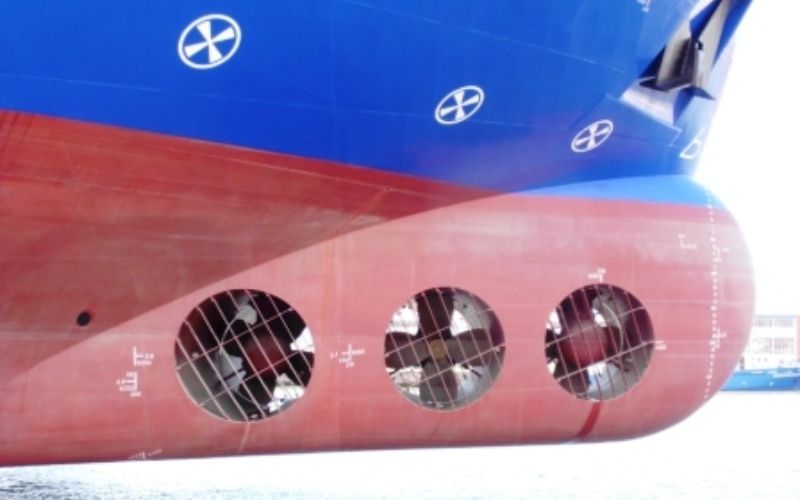
Bow thrusters are mounted in tunnels near the bow. Some cruise ships that have a propeller and rudder arrangement have stern thrusters fitted in addition
Thrusters produce a side thrust that helps the ship maintain lateral control during docking or undocking manoeuvres. Using bow thrusters in combination with Azipod propulsion allows cruise ships to achieve outstanding manoeuvrability and precise positioning, overcoming the limitations of traditional rudders.
While rudders may still be found on some cruise ships, the adoption of Azipod systems and bow thrusters has significantly changed how these vessels navigate through water.
Conclusion
So, do cruise ships have rudders? Some do, but not all of them.
Many cruise ships use traditional propellers and rudders to steer, while others use podded propulsion systems such as Azipods, which can turn to direct the ship without the need for a separate rudder.
Add bow thrusters into the mix and modern cruise ships are surprisingly manoeuvrable for something so huge!
Whichever system a ship uses, there’s a lot more going on beneath the water than you might realise.
